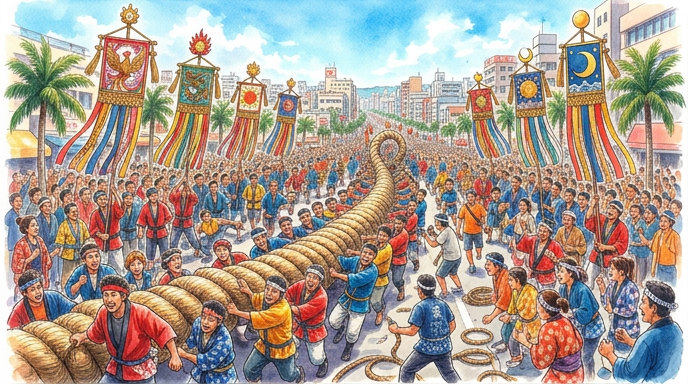
In early October, the entire center of Naha, Okinawa -- National Route 58, which is usually crowded with cars -- becomes the stage for a huge festival.Naha Ootsunahiki Matsuriis a traditional event that has continued since the Ryukyu Kingdom era.Naha OotsunahikiA three-day autumn festival centered around ``. Approximately 15,000 miners in each of the east and west compete to win the world's longest straw rope (accredited by Guinness World Records), which is approximately 200 meters long and weighs approximately 40 tons.
A tropical festival held under subtropical skies that is completely different from the autumn festivals on the mainland. Huge flags called Hatagashira are paraded down Kokusai Dori, traditional performing arts parades decorate the city at night, and on Sundays, tens of thousands of people face each other with a rope between them - an autumn sight that can only be experienced in Naha.
👑 琉球王国と大綱挽き――1450年頃からの伝統
The origins of the Naha Great Tug of War are said to date back to the Ryukyu Kingdom around 1450 AD. At that time, Naha was divided into four towns, north, south, east, and west (Higashi Village, Nishi Village, Wakasa Town Village, and Izumizaki Village), and it is said that this event began when the "Naha Yumachi" joined forces to pull the rope.
The goals are peace of mind for the nation, good harvest, eradication of epidemics, and prosperity of descendants. An ancient document states, ``The tug-of-war ceremony can be held as a prayer for the peace of the first nation and the safety of the venue,'' indicating that it was not just entertainment but a national prayer event. During the Edo period, there are records that it was also held as an event to entertain the magistrates dispatched from the Satsuma domain.
After the abolition of feudal domains and establishment of prefectures during the Meiji period, and the turbulent times of war and reconstruction, the modern Naha Great Tug of War was revived in 1971 (first time). This year 2026 is56th. Today's festival has a history of more than 570 years since the Ryukyu Kingdom, and more than half a century since its revival after the war.
🪢 「世界一のわら綱」の作り方と挽き方
The ropes of the Naha Great Tug of War are not just long and heavy. It is made by twisting many rice straws together by hand by craftsmen and local people. It is a one-time-only rope that is completed just before the festival, dismantled after the festival, and distributed as a souvenir.
| item | numerical value |
|---|---|
| full length | Approximately 200m (male line 100m + female line 100m) |
| gross weight | Approximately 40 tons |
| rope diameter | Approximately 1m58cm |
| Number of reins | 236 pieces |
| grinder | Approximately 15,000 people |
| Participants including spectators | Approximately 275,000 people |
The rope is from the eastWujinaand westernFemale class (Miijina)It is divided into two parts. Both ends are shaped like large rings called Kanuchi, and at the signal to start, the male rope loop is passed through the female loop, and the ring is approximately 20 cm in diameter.Kanachi stick (Kanachi stick)” from above to join the two. This moment of union is one of the most tense parts of the festival.
After the ropes are tied together, the cutters, who are separated from the east and west, begin pulling the rope all at once, chanting "Haiya, haiya!" The time limit is 30 minutes. The winner is the one whose rope moves more than 5 meters within this time; if the rope does not move, it is a draw. Moving a 40-ton rope by hand is no mean feat, and there are many years when the competition ends in a draw.
🎏 旗頭行列――村々の誇りが国際通りに集う
Before the actual tug-of-war, there is another highlight. Gathering from 14 districts in Naha CityHatagashira--It is a procession of huge decorative flags that are 7 to 10 meters high and weigh several dozen kilograms.
The flag head originally symbolized the prosperity and guardian deity of each village. The flag's headdress has a different symbol for each village (a crane, a phoenix, the sun, the moon, a sphere, an animal, etc.), and the bearer supports it with one hand as it moves along Kokusai Street, swaying while chanting. This matrix isUfunnasunei (Otsuna Zuneei)It is called the Tug of War and is held in the morning on the day of the tug of war.
In addition, on the Saturday night before the Grand Tug of War, "Traditional performing arts night parade & citizen on stage” will be held, and the streets will be filled with Eisa (traditional Okinawan drum dance), lion dancers, flag leaders, modern dance teams, and more. A unique feature of the Naha Great Tug of War Festival is that it is designed so that the festival continues throughout the three days.
📅 2026年 スケジュール
| schedule | time | event | place |
|---|---|---|---|
| Saturday, October 10th | 17:00-20:30 | Traditional performing arts night parade & citizen on stage | Kokusai Street |
| October 10th-12th | all day | RBC Citizens Festival (Stage/Stores) | Onoyama General Sports Park |
| Sunday, October 11th | 11:30-14:00 | Flaghead procession (Ufunnasunei) | Kokusai Street |
| Sunday, October 11th | 14:30-17:00 | Naha Great Tug of War (actual) | National Route 58/Kumoji intersection |
| October 12th (Monday/Holiday) | all day | Last day of citizen festival | Onoyama General Sports Park |
*Times are estimates for previous years. For details, please check the official announcement from the Naha Great Tug of War Preservation Society or the Naha City Tourism Association.
📝 楽しみ方のポイント
Participate as a grinder:The biggest attraction of the Naha Great Tug of War is that even tourists can freely participate as tug-of-war players. There is no need to pre-register, just go to the venue (near the Kumoji intersection) a little before the start time, grab the ``reins'' that extend from the rope, and from that moment you become part of the festival. This is the only place you can get the experience of pulling the world's largest straw rope with your own hands.
A piece of rope is a lucky charm:After the festival is over, the rope is dismantled and you can take the pieces home. There is a custom in Okinawa to display the rope you bring home at your front door as a talisman for good health and family safety. It would be helpful to have scissors or a cutter, but please compromise with others.
The flag parade will take place on Kokusai Street:Roadside areas around Makishi, Heiwa Dori, and in front of the prefectural office are suitable for viewing. The moment when the flag head swings up and down is very impressive and makes for a great photo.
Clothes and things to bring:Even in October in Naha, the temperature during the day is around 25-28℃, and there are days when the sun is strong. A hat, sunscreen, and water are essential. If you are participating as a grinder, please wear clothes that are easy to move in and sturdy sneakers (avoid sandals). Your hands will turn black when you hold the rope, so wear clothes that you don't mind getting dirty.
In case you get separated:The venue will attract hundreds of thousands of people. It is best to decide on a meeting place with your companions in advance.
🚃 アクセス
| Place of departure | route | Time required |
|---|---|---|
| Tokyo (Haneda) | Airplane → Naha Airport | Approximately 2 hours 45 minutes |
| Osaka (Kansai Airport/Itami) | Airplane → Naha Airport | Approximately 2 hours 20 minutes |
| naha airport | Yui Rail → Kenchomae Station/Miebashi Station | Approximately 15 minutes |
| Kenchomae Station | Walk to the Grand Tug of War venue (Kumoji intersection) | Approximately 5 minutes |
On the day of the tug of war, large-scale traffic restrictions will be in place around the Kumoji intersection on National Route 58, making it almost impossible to approach by car.Yui Rail (Okinawa Urban Monorail)The most reliable option is to use , and it is within walking distance from Kencho-mae Station, Miebashi Station, and Makishi Station. Hotels are conveniently located in the center of Naha city (around Kokusai Dori), but they tend to be fully booked during the festival period, so be sure to book early.
🌺 南国の祭りが教えてくれること
While Honshu's autumn festivals have developed around gratitude for the harvest and prayers to the spirits of ancestors, the Great Tug of War in Naha conveys the memories of the independent Ryukyu Kingdom, such as ``national peace,'' ``competition of power between towns,'' and ``community unity.'' Even though Japan's autumn festivals are the same, the history behind them is completely different.
Just like Toyama's Owarakaze Bon festival, which we introduced in September, and Nagasaki Kunchi festival in early October, the Naha Great Tug of War is also one of the ``festivals that could only have been born in that area.'' A different rhythm, different language, and prayers to different gods than the Yamato festival - there is ``another autumn'' in Japan on the streets of Naha.
Holding the rope, sweating, I raised my voice along with the stranger standing next to me. For these three days, Naha will transform into a festival city. Please join in the excitement as one of the artisans.