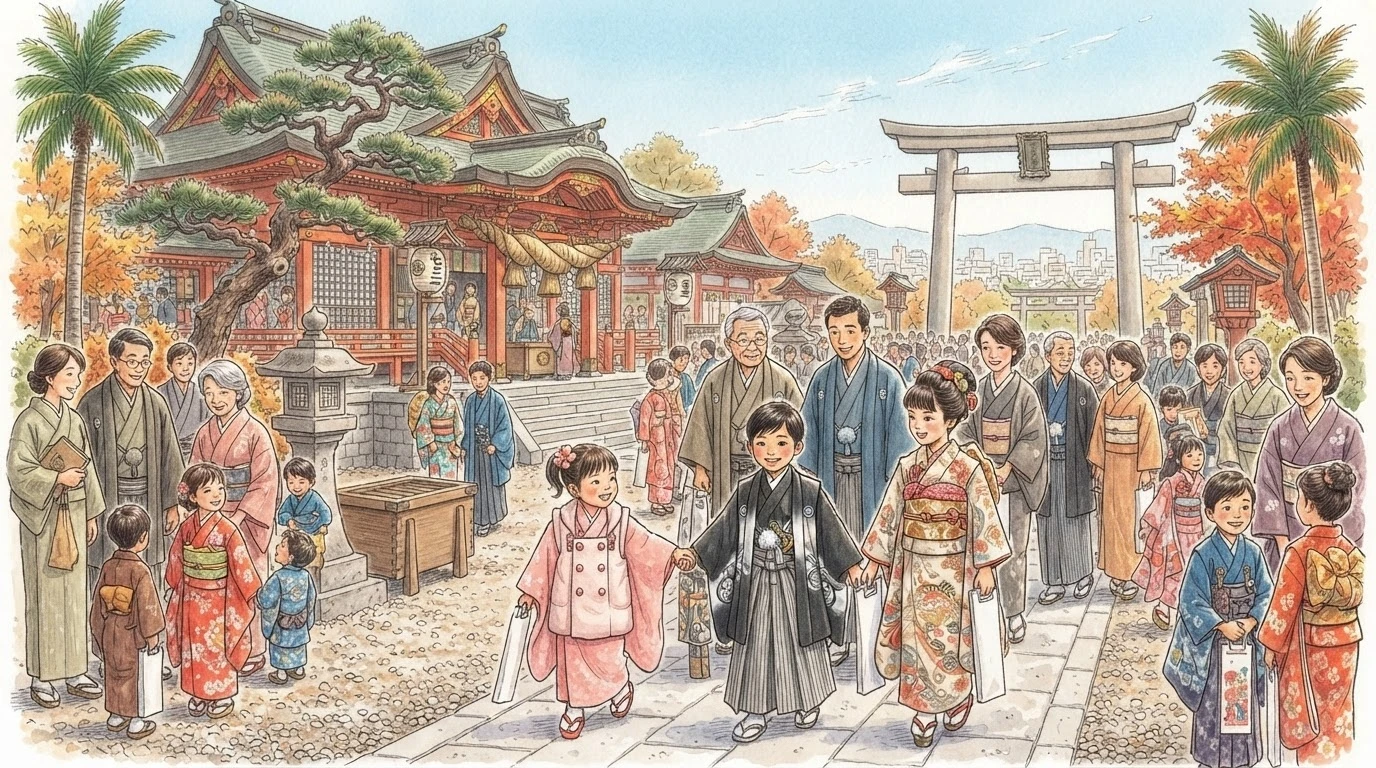
As we reach the middle of October, a common sight can be seen in the precincts of Japanese shrines. Children aged 3, 5, and 7 are seen wearing brightly colored kimonos and hakama as they visit the shrine, led by their parents and grandparents. A long bag in his hand. Inside is a stick-shaped candy colored red and white.
This isShichi-Go-San--It is the most widely popular rite of passage in Japan that celebrates a child's growth. The original day is November 15th, but in recent years, more and more families are starting to visit the shrine in October to avoid crowds and bad weather, and at this time of year shrines are filled with children in their best clothes.
🎎 三つの古い儀式――七五三のルーツ
Although Shichi-Go-San appears to be a single event, it originally originated as three separate ceremonies. It began in the imperial court during the Heian period, and as it spread to the general public during the Edo period, celebrations based on each age group became established.
3 years old “Kamioki” -During the Heian period, it was customary for children to have their hair shaved until they were three years old to prevent illness. At the age of three, children begin to grow their hair for the first time. The ceremony to celebrate this milestone is the ceremony of hair placement. Both men and women are eligible. It was also customary to place white cotton or thread on your head, wishing that you would live long enough to have gray hair.
5 years old "Hakamagi" ---A ritual in which a five-year-old boy puts on a hakama for the first time. The etiquette of standing on a Go board, facing the auspicious direction, and wearing a hakama is still practiced at some shrines. Standing on the Go board also has the meaning of ``taking over the world as the leader of one country and one castle.''
7 years old "Obitoki" ---This is a ritual in which a seven-year-old girl removes the strings that had previously held her kimono in place and ties the obi for the first time in the same way as an adult. It signified the turning point from a child to a girl. It is also called "himootoshi".
It is said that these three ceremonies were combined into one numerical sequence of ``7, 5, and 3'' after the Meiji period. Until the Edo period, it was celebrated individually in each home and region.
📅 なぜ11月15日なのか
The original date of Shichi-Go-San is November 15th. There are several theories about the origin of this date, but the most likely one isTokugawa TsunayoshiThis is an anecdote related to this.
On November 15, 1681, Tsunayoshi gave birth to his frail eldest son,Tokumatsu (Tokumatsu)A grand celebration was held to pray for the health of all. It is said that this day spread among samurai families and townspeople, and became established as a day to celebrate children's growth (Despite this celebration, Tokumatsu died young at the age of 5).
Another strong theory is the auspicious day theory of the calendar. November 15th of the lunar calendar is ``28 days old'' in the Chinese calendar system called ``28 Shukus.''Kishuku-nichiIt was a special day. This day was considered to be the perfect day for all kinds of celebrations other than weddings, as demons would stay at home and not go out. In addition, November was also the month of ``Ichiyo Raifuku'' in Onmyodo, an auspicious month when the light of the sun begins to return toward the winter solstice.
It is generally understood that November 15th was established as Shichigosan Day due to a combination of Tokumatsu's anecdote and the auspicious day of the calendar.
🍬 千歳飴――長寿を包む細長い飴
That long, slender bag held in the hands of Shichi-Go-San children. Inside is ``Chitose-ameIt contains a red and white stick-shaped candy called ``. The elongated shape of the candy itself symbolizes ``living thin and long = longevity,'' and Chitose candy is an indispensable lucky charm for Shichi-Go-San.
Chitose candy is said to have its origins in the Edo period, from the Genroku to Hoei years (1688-1711). Shichibei, a candy seller in Asakusa, Edo, sells stick-shaped candy dyed red and white.SennenameThe most widely known theory is that they started selling them in the precincts of Sensoji Temple under the name ``. Because of its auspicious name, ``Millennium,'' and its elongated shape, which suggests longevity, it became popular as a candy suitable for children's celebrations.
There are standards for Chitose Ame. The length must be within 1 meter and the diameter must be within 15 mm, and if it exceeds this limit, it cannot be called "Chitose Ame". The bags are gorgeously decorated with auspicious motifs of longevity, such as pine, bamboo, and plum blossoms, cranes and turtles, and old men and women. The sight of children walking around carrying bags as big as themselves is a typical Shichi-Go-San tradition.
Candy is very hard, so instead of biting it whole, you lick it little by little, break it with a knife and eat it in smaller pieces, or use it in cooking. It is interesting that ``breaking'' food is sometimes considered bad luck, and the customs of how to eat it vary from family to family.
🎂 数え年か、満年齢か
When should we celebrate Shichigosan? What many families worry about at some point is the difference between Kazoe-doshi (counting years) and Man-nenrei (full age).
In Japan, there was originally a way to count age called ``Kakanen''. The moment you are born, you turn one year old, and every New Year, everyone turns one year older at the same time. Using this method of counting, a child born on New Year's Eve will already be 2 years old the next day. Shichi-Go-San was originally an event celebrated during this number of years.
On the other hand, "full age", which is commonly used in modern Japan, is a method of counting one year older for each birthday, which is a common method internationally. A law in 1902 officially established the legal age, and it was officially made common by law in 1950 after the war.
Today, most families celebrate Shichi-Go-San at full age. However, there are many families who celebrate in counting years, and the general position of shrines is that either is fine. In particular, more and more families are celebrating their 3rd birthday, as many children dislike wearing kimonos or cry while visiting shrines when they are in their third year (around 2 years old). There is not much difference between 5 and 7 years old, whether it is a counting year or a full age, so it is common to decide on the timing according to the family policy and the timing of siblings.
👘 現代の七五三――前撮り、後撮り、参拝日の分散
Originally, Shichi-Go-San was traditionally held on November 15th by visiting the shrine in best clothes and taking pictures on the same day. However, in modern homes, a style that does not focus on this day has become mainstream for several reasons.
Pre-shot:A method in which you take photos of yourself in traditional Japanese clothes at a photo studio between April and October. Many families choose this because they can enjoy a different scene on the visit day in November. From summer to early fall, the studio is crowded with families taking pictures in advance, and one of the reasons it's so popular is that you can get pictures taken at a campaign price.
After-shot:This is a method of taking pictures slowly during the off-season after December, when the Shichi-Go-San season has ended. It's easy to make reservations, and the benefit is that the whole family can relax after the crowds of Shichi-Go-San.
Dispersion of worship days:An increasing number of families are choosing weekends or Daian Days from mid-October to late November to visit the shrine, rather than focusing on November 15th. November 15, 2026 falls on a Sunday, so it is expected to be very crowded, and many families will finish their trip in October.
If you see parents and children wearing kimono at a Japanese shrine between October and November, it is almost certainly a visit to the Shichi-Go-San festival. The shrine also sets up a special prayer reception during this time, and welcomes families with Chitose candy and souvenirs.
🎌 晴れ着に込められた意味
Children of Shichi-Go-San have different manners depending on their age. Once you learn about the differences in the best clothes for each age group, you will be able to see the children you see on the grounds even more deeply.
| age | sex | Attire | meaning |
|---|---|---|---|
| 3 years old | man and woman | Hifu and kimono | Without tightening the obi yet, I put on a sleeveless vest-like ``cover''. A plump and adorable figure. |
| 5 years old | 男 | crested haori hakama | Formal attire associated with the hakama-wearing ceremony. A haori with a family crest on it, a hakama, and a protective sword on the waist. The appearance of a "little samurai". |
| 7 years old | 女 | Yotsumi kimono and round obi | In conjunction with the obi-untied ceremony, the obi is officially tied for the first time. Her hair is tied up, making her look much more mature. |
Children's best clothes are themselves traditional crafts. Dyeing, embroidery, obi tying - all of these beautiful Japanese garments are the result of highly skilled techniques, and even in today's world where people rent their clothes, their high quality remains unchanged. In some families, the kimono inherited from grandparents is passed down from generation to generation, and it is also a day to wear the history of the family itself.
📝 七五三の日を街で味わう
Timing for visiting shrines:On weekends from mid-October to late November, many parents and children can be seen making the Shichi-Go-San pilgrimage at major shrines in major cities (Meiji Shrine, Omiya Hachiman Shrine, Hie Shrine in Tokyo, Heian Shrine in Kyoto, Sumiyoshi Taisha Shrine in Osaka, etc.). The precincts are gorgeous and lively, and it's a great opportunity to get a glimpse of Japanese family culture.
Photography etiquette:Children in kimonos are so adorable that you'll want to take pictures of them, but please avoid taking pictures of children from other families. If you want to take pictures, be sure to ask a parent for permission. There is no problem in taking pictures of the entire scenery of the temple grounds.
Get Chitose Ame:Chitose candy can be purchased at shrines during the Shichi-Go-San season, as well as at Japanese sweets shops, major supermarkets, and department stores. Bags with pictures of pine, bamboo, and plum blossoms and cranes and turtles are beautiful as crafts, and can also be used as souvenirs of your travels.
Sensoji Temple and Chitose Ame:Traditional candy shops still line the streets around Sensoji Temple in Tokyo, which is said to be the birthplace of Chitose candy. In addition to Chitose Ame, there are also shops where you can experience Japanese candy culture, such as Kintaro Ame, and the area is especially crowded during the Shichigosan season.
Experience with kimono rental:Kimono rentals for adults are abundant in tourist areas in Kyoto and Tokyo. If you wear a kimono and walk around the shrine yourself at the same time as Shichi-Go-San, you will be able to blend in more naturally with the scenery of families visiting the shrine, and deeply experience autumn in Japan.
🌸 子どもの節目を、みんなで祝うということ
The reason behind the continuation of Shichi-Go-San lies in the harsh reality that in the past, it was never taken for granted that children would grow up safely in Japan. There was a time when children up to the age of seven were thought to be part of God, and it was thought that they might return to the other world at any moment. That is why a ritual was created to express gratitude to the family, community, and God each time a child successfully reaches the milestones of turning three, five, and seven years old.
In modern Japan, the infant mortality rate is among the lowest in the world, and raising a child is no longer a miraculous event. However, Shichi-Go-San, far from becoming obsolete, is repeated every year as an autumn tradition. The whole family celebrates their child's growth, keeps it as a memento, takes pictures, gives them candy, and takes them to the shrine. This act itself is an important ritual that confirms family ties and the passage of the seasons.
If you have a chance to travel to Japan between October and November, be sure to stop by the shrines. A three-year-old girl walks strenuously on the gravel path in the shrine grounds in brand new sandals. A five-year-old boy wearing a haori hakama and a protective sword. A seven-year-old girl carefully carries a long bag. Their day has been passed down from the Heian Imperial Palace for 1200 years, and is still carefully passed down in this country. If you spot such children in the autumn scenery of Japan, it's a lucky trip.