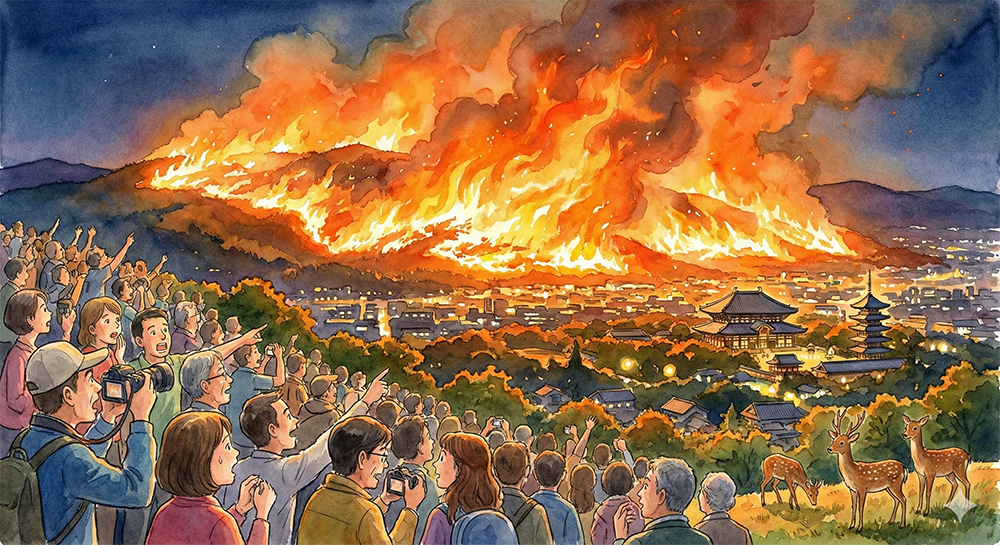
On the fourth Saturday of January, the night sky over the ancient capital of Nara glows red.
It is not an accident or a wildfire. It is Wakakusa Yamayaki (the burning of Mt. Wakakusa), a tradition that has continued for hundreds of years.
In this spectacular event, an entire 342-meter mountain is set ablaze, and together with fireworks it fills the cold winter sky with heat.
Why would the Japanese set fire to a beautiful, grass-covered mountain?
🔥 Born From a Dispute? Flames of Remembrance
There are several theories about its origin, but the most famous involves a boundary dispute.
In the Edo period, two great neighboring temples, Todaiji and Kofukuji, quarreled over their boundary, and burning the mountain is said to have begun as a way of settling it. (Today it is held to comfort and honor the spirits of those who came before, and for fire prevention.)
Viewing Tips
On the day, several hundred fireworks are launched first, and right after that the mountain is lit all at once.
- Visual contrast: The clear winter night sky, the light of the fireworks, and the bands of red flame creeping across the slopes. The contrast of these three is breathtaking.
- Preparing for renewal: The burned mountain turns black, but the ash becomes fertilizer, and in spring even more beautiful new grass (wakakusa) sprouts. These are flames not of destruction but of renewal.
The whole mountain is wrapped in flames for only about 30 minutes to an hour.
That fleeting yet powerful sight is sure to be a highlight of a winter trip to Japan.